COMPUTATIONAL MODELLING FOR SOCIAL AND BEHAVIOURAL DYNAMICS AND IMPACT ASSESSMENT
1. Overview
Agent-Based Modeling (ABM) is a powerful computational approach where individual entities (agents) interact within a dynamic environment. These interactions collectively produce emergent behaviour that cannot be reproduced using traditional equation-based modeling methods.
My work in ABM focuses on combining real-world human mobility traces, ML-driven behavioural clustering, and agent stochastic simulation into a unified ABM system to model airborne (COVID-19) and vector-borne (dengue) diseases with high behavioural realism.
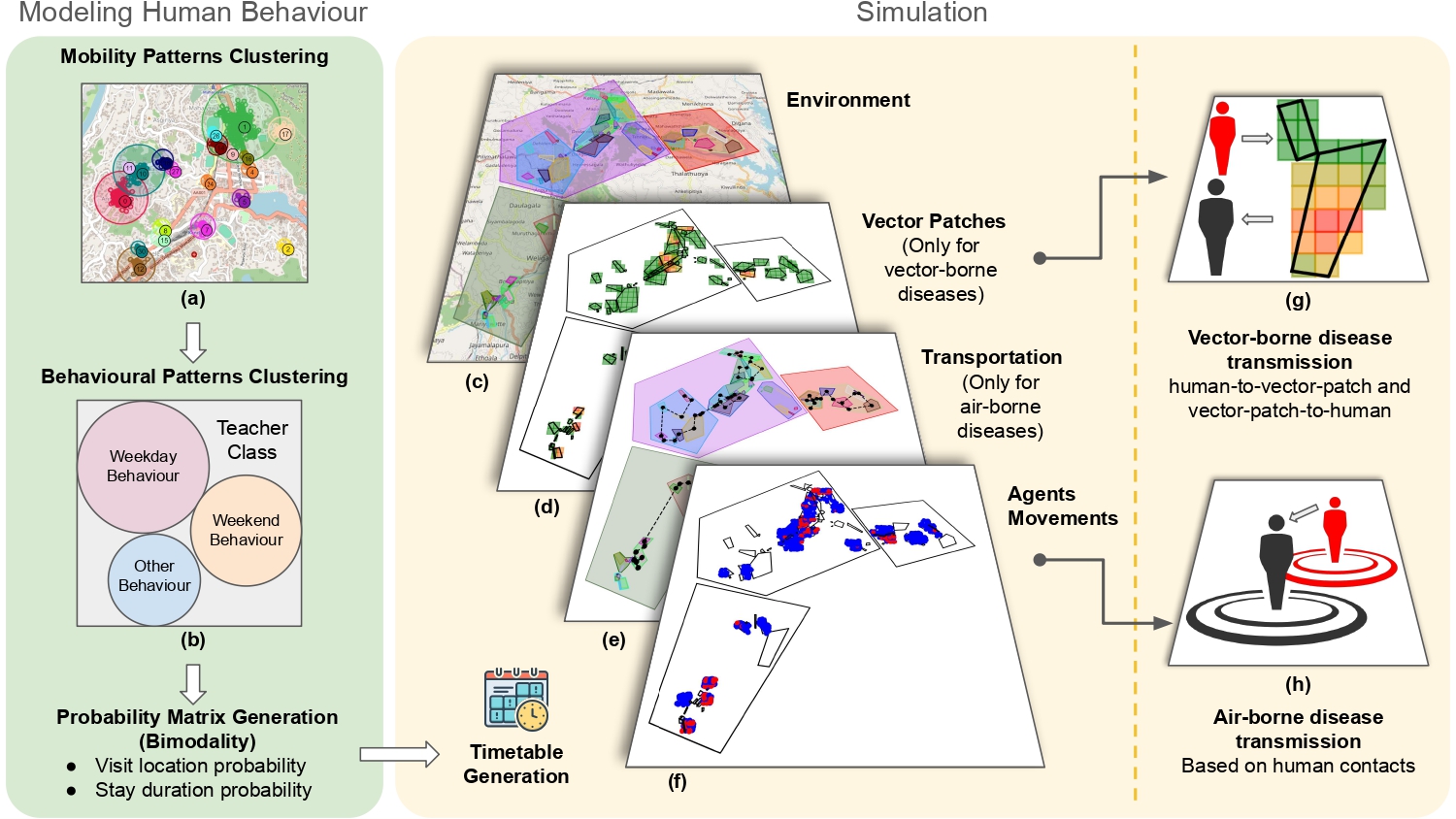
Graphical project abstract explaining different layers that coexist within the designed ABM system.
2. Key Features of the Project(ADD MORE DETAILS !)
- Real-world GPS mobility modeling from 100 human participants from different occupations.
- Behavioural extraction using DBSCAN and Spectral Clustering.
- High-fidelity simulation of COVID-19 and dengue.
- Transportation-aware exposure modeling (buses, shared mobility).
- Policy evaluation: quarantine, vaccination, social distancing, hotspot elimination.
- Hybrid ABM + SEIR framework for epidemiological accuracy.
3. Technical Highlights
- State-machine models for occupational daily routines.
- Graph-theoretic contact modeling for exposure estimation.
- Patch-based vector population modeling for dengue (temperature, humidity, rainfall).
- Probabilistic transmission for airborne and vector-borne infection.
- AI-based identification of mobility clusters and risk zones.
4. Results
Different experimental results are posted here. Will be UPDATED SOON!!!
5. Project Poster
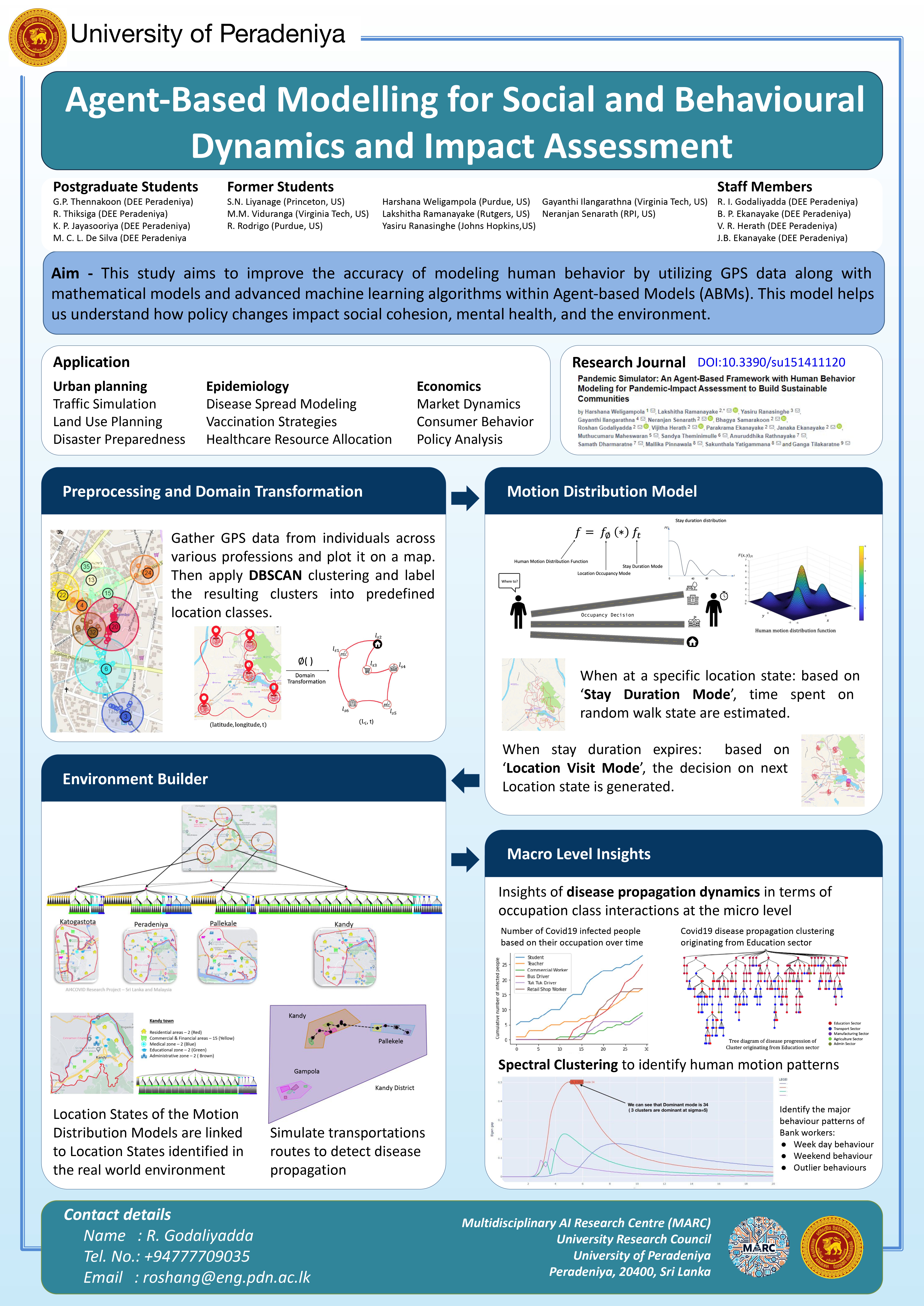
Project poster for the Research Project(Click to Download).
6. Resources
Journal Paper
AVSim:Realistic Simulation Framework for Airborne and Vector-Borne Disease Dynamics
Under Review at IEEE Transactions on Systems, Man and Cybernetics.
Conference Paper
"Unveiling Motion Patterns through Unsupervised Clustering"
🏆 Outstanding Paper Award
Presented and Published at ICAC 2024
Dataset
Includes real-world mobility traces from 100 participants across 13 occupations. Study conducted in Sri Lanka.
GitHub Code
Full implementation of the agent-based epidemic simulation system.
Full Project Report
EE406 Final Project Report (PDF)
Final-year project documentation with methodology, results, and evaluations.